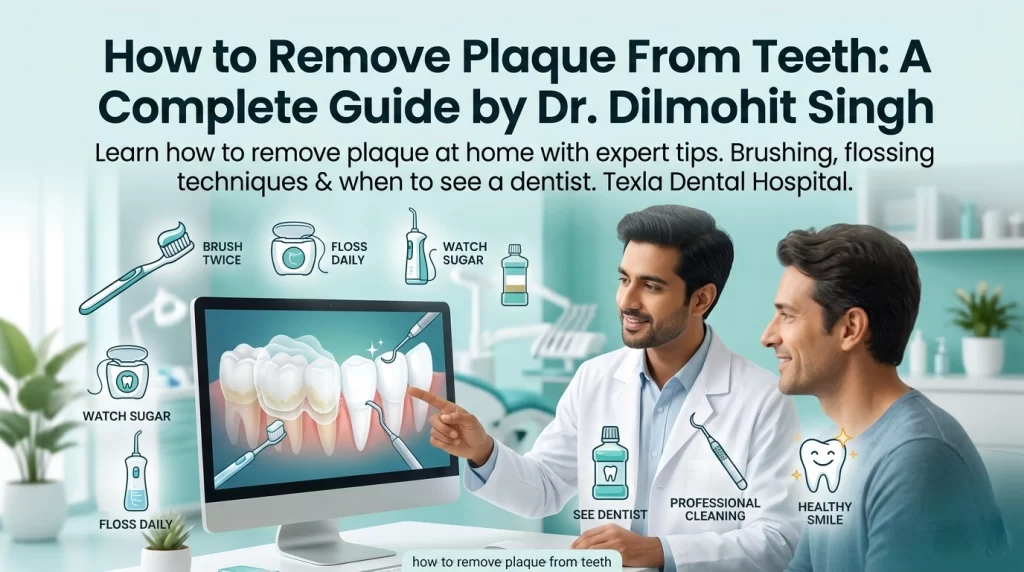
Are your teeth feeling rough or looking slightly yellowed even after brushing? That could be dental plaque at work. As a dentist, one of the most common questions I get from patients at Texla Dental Hospital is: how to remove plaque from teeth effectively — and more importantly, how to stop it from coming back.
In this guide, I’ll walk you through everything you need to know about plaque — what it is, what causes it, how to remove it at home, and when it’s time to visit a professional. Let’s get into it.
What Is a Dental Plaque?
Dental plaque is a soft, sticky, colourless film made up of bacteria that forms on your teeth throughout the day. Every time you eat or drink — especially sugary or starchy foods — these bacteria feed on those food particles and produce acids that attack your tooth enamel. Over time, this can lead to cavities, tooth sensitivity, and gum disease.
The tricky thing about plaque is that it forms constantly. Even after you’ve just brushed, it starts building up again. That’s why consistent oral hygiene isn’t optional — it’s essential.
If plaque is not removed regularly through brushing and flossing, it hardens into tartar (also called dental calculus). Once tartar forms, no amount of brushing at home will remove it — you’ll need a professional cleaning at a dental clinic like Texla Dental Hospital.
What Causes Plaque on Teeth?
Plaque builds up when naturally occurring bacteria in your mouth interact with the foods you eat. The primary culprits are:
Sugary foods and drinks – sodas, candy, fruit juices, and sweetened teas
Starchy foods – bread, crackers, chips, and pasta
Infrequent or improper brushing – leaving food debris on teeth for extended periods
Dry mouth – saliva helps neutralise acids and rinse away debris; reduced saliva flow encourages plaque growth
Skipping flossing – plaque thrives between teeth where toothbrushes can’t reach
The bacteria in plaque metabolise sugars and starches and produce acids as a by-product. These acids erode your enamel gradually — and if plaque is allowed to accumulate under the gumline, it can lead to gum inflammation, bleeding gums, and eventually periodontitis (a severe form of gum disease).
How to Remove Plaque From Teeth at Home
The good news is that plaque — before it hardens into tartar — can be effectively removed at home with the right habits. Here’s how:
Brush Correctly, Twice a Day
This is the single most impactful thing you can do. Brush your teeth at least twice a day, ideally after meals, for a full two minutes each time.
Here are my key brushing tips:
Use a soft-bristled toothbrush — medium or hard bristles can damage enamel and irritate gums
Use fluoride toothpaste — fluoride strengthens enamel and helps prevent cavities
Hold your brush at a 45-degree angle to the gumline
Use gentle, circular motions — aggressive scrubbing does not remove more plaque; it just damages your gums
Don’t forget to brush your tongue, where bacteria also accumulate
Replace your toothbrush every 3 months or when bristles start to fray
Floss Daily — No Excuses
I cannot stress this enough: brushing alone is not enough. Your toothbrush cannot clean the tight spaces between your teeth, which are prime zones for plaque accumulation.
Floss at least once a day, preferably before bedtime. Here’s how to do it right:
- Use about 18 inches of floss, winding most of it around your middle fingers
- Gently guide the floss between teeth using a zigzag motion
- Curve the floss into a “C” shape around each tooth and slide it under the gumline
- Use a clean section of floss for each tooth
If traditional flossing is difficult — particularly for those with braces or dental bridges — consider using:
- Water flossers (oral irrigators): These use a pressurised stream of water to clean between teeth and along the gumline. They’re especially effective for people with orthodontic appliances.
- Interdental brushes: Small, cone-shaped brushes designed to fit between teeth. Very useful if you have wider gaps or wear dental implants.
- Floss picks: Convenient pre-threaded flossers that are easier to manoeuvre than traditional floss.
Use an Antibacterial Mouthwash
Rinsing with an antiseptic or antibacterial mouthwash once a day — ideally at a different time from brushing — helps reduce the bacteria that form plaque. Look for mouthwashes containing chlorhexidine or cetylpyridinium chloride for anti-plaque benefits.
Mouthwash is not a substitute for brushing and flossing — it’s an additional layer of protection.
Watch What You Eat
Diet plays a more important role in plaque formation than most people realise. To minimise plaque buildup:
- Limit sugary snacks and beverages — every time sugar enters your mouth, bacteria get a fresh fuel supply
- Drink more water — water washes away food debris and neutralises acids
- Eat crunchy fruits and vegetables — foods like apples, carrots, and celery have a mild mechanical cleaning effect on teeth
- Choose dairy products — cheese and yoghurt contain calcium and phosphates that help remineralise enamel
Consider a Plaque-Disclosing Tablet
The plaque is colourless, which makes it hard to see. Plaque-disclosing tablets or solutions temporarily stain plaque pink or purple, allowing you to see the areas you’ve missed while brushing. These are a great tool — especially for children — to improve brushing technique.
When Home Care Isn’t Enough: Signs You Need Professional Plaque Removal
If plaque has already hardened into tartar, no home remedy will remove it. At that point, you need a professional dental cleaning (scaling) performed by a dentist or dental hygienist.
Visit Texla Dental Hospital if you notice any of the following:
- Yellow or brown deposits on your teeth, especially near the gumline
- Bleeding gums when you brush or floss
- Persistent bad breath despite good oral hygiene
- Gum swelling, redness, or sensitivity
- Teeth that feel rough or unclean even after brushing
During a professional cleaning, we use specialised instruments (ultrasonic scalers and hand scalers) to carefully remove tartar from the tooth surface and below the gumline — something that simply cannot be replicated at home.
How to Prevent Plaque from Building Up
Prevention is always better than cure. Here’s a quick summary of the habits that will keep plaque at bay:
Habit | Frequency |
Brush with fluoride toothpaste | Twice daily (2 minutes each) |
Floss or use interdental cleaner | Once daily |
Use antibacterial mouthwash | Once daily |
Professional dental cleaning | Every 6 months |
Dental check-up | Every 6 months |
A Word on Oil Pulling and Home Remedies
Patients often ask me about oil pulling, baking soda, or activated charcoal as plaque removal solutions. While some of these practices may offer mild benefits — for example, oil pulling has some evidence for reducing bacteria — none of them are proven substitutes for brushing, flossing, or professional cleaning. Baking soda can be mildly abrasive and may help with surface staining, but it does not eliminate plaque biofilm. I’d encourage using these only as complements to — never replacements for — standard oral hygiene.
Final Thoughts from Dr. Dilmohit Singh
Knowing how to remove plaque from teeth is the foundation of good oral health. Plaque is a daily reality, but with the right routine — brushing, flossing, rinsing, and eating well — you can keep it from doing lasting damage to your teeth and gums.
At Texla Dental Hospital, we believe in empowering our patients with the knowledge and tools to take charge of their oral health between visits. But regular professional cleanings remain irreplaceable, especially for removing tartar and catching early signs of gum disease or cavities.
If you haven’t had a dental check-up recently, I’d encourage you to book an appointment with us today. Your smile is worth it.
Frequently Asked Questions
Q: Can I remove plaque from my teeth at home?
Yes — soft plaque can be effectively removed at home through regular brushing with fluoride toothpaste and daily flossing. However, once plaque hardens into tartar, it requires professional removal by a dentist.
Q: How often should I get a professional cleaning to remove plaque and tartar?
Most adults should schedule a professional dental cleaning every six months. If you are prone to tartar buildup, gum disease, or other dental conditions, your dentist may recommend more frequent visits.
Q: Does mouthwash remove plaque?
Mouthwash alone does not remove plaque, but an antibacterial mouthwash used alongside brushing and flossing significantly reduces the bacteria responsible for plaque formation.
Q: Is plaque removal painful?
Removing soft plaque through brushing and flossing is completely painless. Professional scaling is generally well-tolerated, though some patients may experience mild sensitivity — especially if gums are inflamed or tartar buildup is heavy.
Q: What happens if plaque is left on teeth?
If left untreated, plaque causes tooth decay, cavities, and gum disease. It can harden into tartar, lead to gingivitis (early gum disease), and eventually progress to periodontitis — a serious infection that can result in bone and tooth loss.
Q: Can children get plaque?
Absolutely. Children are just as susceptible to plaque buildup as adults. Teaching good brushing and flossing habits early, and scheduling regular dental check-ups for children, is essential for lifelong dental health.
For a perfect, long-term, and result-oriented oral solution, always choose the best dental clinic near you. Texla Dental Hospital is at your service with all its perfections within the serving areas:
This article is for informational purposes only and does not constitute medical advice. Please consult Dr. Dilmohit Singh or another qualified dental professional at Texla Dental Hospital for personalised guidance on your oral health.